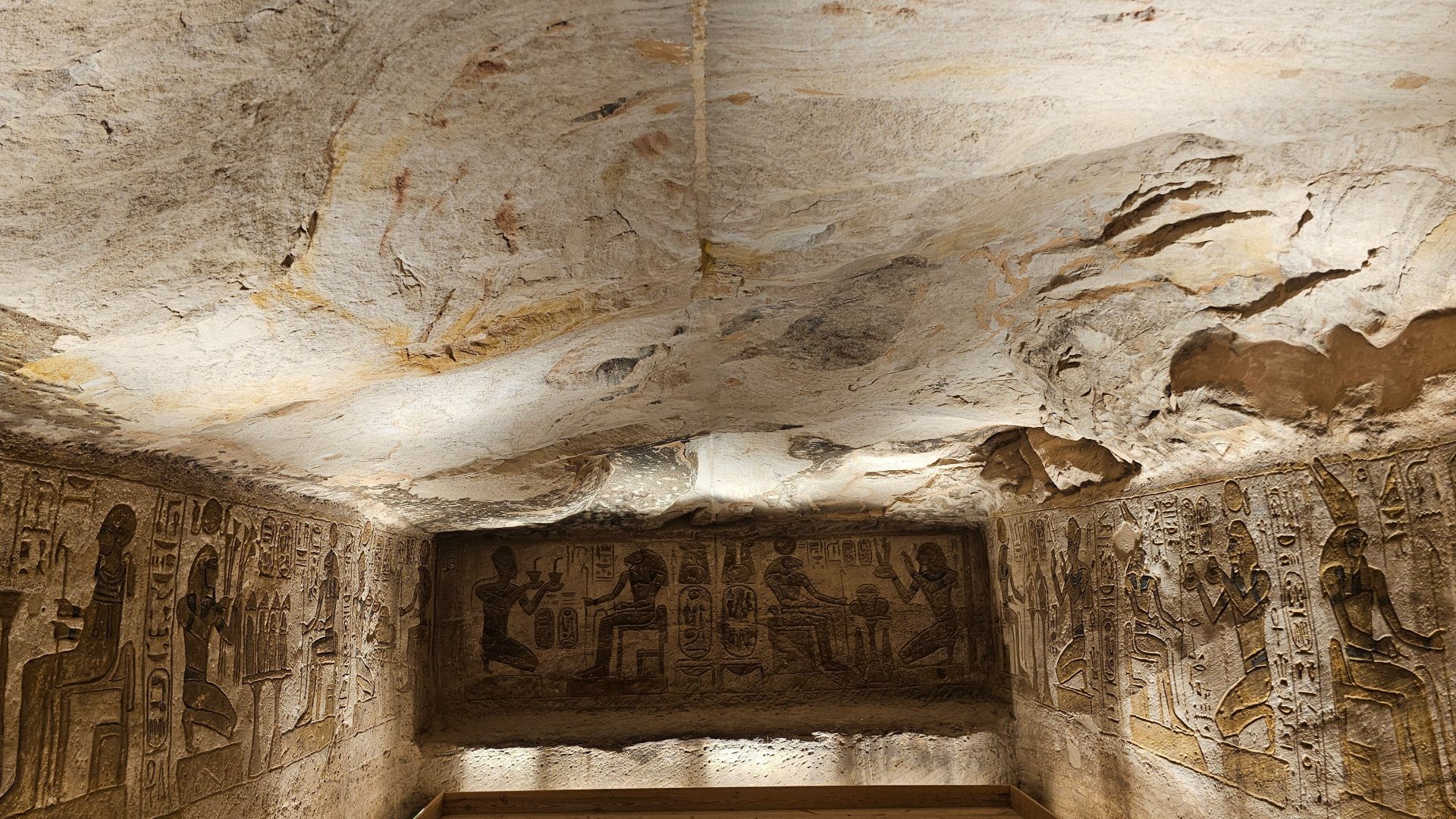
Uncovering Ancient Secrets: Satellite Imagery Suggests the Existence of Egypt’s ‘Labyrinth’
Recent satellite scans of Egypt have sparked renewed interest among archaeologists and history enthusiasts alike, as they potentially reveal the location of the legendary ‘Labyrinth of Egypt.’ This colossal underground complex, believed to encompass approximately 3,000 chambers, may contain both historical artifacts and mysterious structures, including a striking metallic object roughly 40 meters in length.
Satellite Discoveries Indicate Monumental Structures
The innovative use of satellite imaging technology has enabled researchers to identify anomalies beneath Egypt’s desert surface that could correspond to the historic labyrinth described by ancient sources. Notably, one discovery highlights a large, centrally positioned, freestanding object, estimated to be about 40 meters long. Preliminary assessments suggest this object possesses a metallic composition, a significant detail given that most known structures from that era are primarily stone or wood. Its shape has been poetically likened to a Tic Tac mint, fueling speculation about its nature.
Historical Accounts and the Mythical Labyrinth
The existence of such vast underground chambers was documented by Herodotus, the ancient Greek historian. He described a complex with double sets of chambers—around 3,000 in total—split evenly above and below ground. Herodotus recounted that Egyptian custodians were reticent to reveal the full extent of these underground spaces, which has contributed to their elusiveness in modern archaeological exploration.
The Ongoing Saga of Archaeological Transparency
Despite technological advancements, access to these potential discoveries remains limited. Past satellite imagery releases have faced significant obstacles, including restrictions imposed by Egyptian authorities under the guise of national security. The scientific community and enthusiasts alike have voiced frustration over limited transparency and the suppression of information that could shed light on Egypt’s ancient history beyond well-known monuments like the pyramids.
Controversies and Speculations
Some critics question the narrative that most artifacts and structures have been looted or destroyed, suggesting that some significant finds might still be concealed. The tendency for certain findings, especially those hinting at alternative theories of Egyptian history, to be suppressed underscores ongoing debates. Notably, efforts by international teams employing proven satellite techniques have encountered resistance or outright dismissal from local authorities.
Looking Forward
While the mystery persists, the potential for future discoveries remains promising. Advances in non-invasive imaging and international cooperation could eventually lead to more openness regarding Egypt’s hidden past. For now, the enigmatic ‘Labyrinth
0 thoughts on “Sattelites scans of Egypt may have revealed the location of the ‘Labyrinth of Egypt’, a massive, 3000 chamber library including a metal ‘tictac’ shaped object about 40m long.”