Exploring the Recent Passage of 3I/Atlas Near Mars: A Closer Look at a Unique Interstellar Visitor
In an extraordinary celestial event, the interstellar object 3I/Atlas recently made its closest approach to Mars, passing our neighboring planet just minutes ago. This event has captivated astronomers and space enthusiasts alike, prompting discussions about the true nature of this intriguing object.
A Brief Overview of 3I/Atlas
Discovered in 2019, 3I/Atlas is recognized as one of the first identified interstellar objects passing through our solar system. Unlike objects that originate within our Sun’s neighborhood, interstellar visitors have origins beyond the solar system, offering scientists invaluable insights into distant planetary systems.
Recent Observations and Imaging
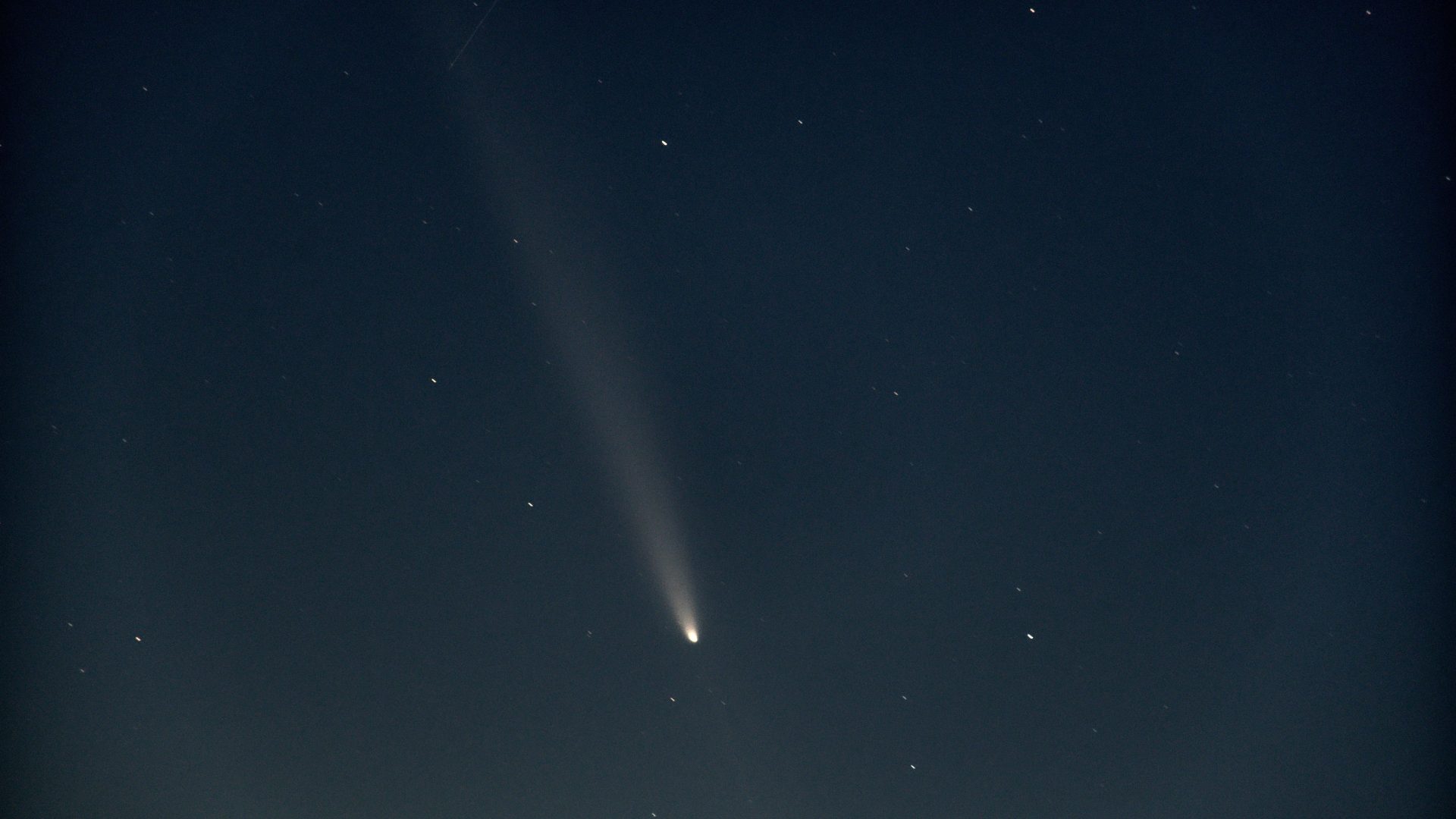
During its passage, the Perseverance rover, operating on Mars and on Sol 1643 of its mission, captured images of 3I/Atlas as it traversed the Martian vicinity. These images have provided a rare opportunity to analyze the object’s physical characteristics up close.
Physical Characteristics and Shape
Contrary to typical expectations of cometary shapes, preliminary observations suggest that 3I/Atlas exhibits an unusually cylindrical form. This shape stands out from the more irregular or spherical forms commonly observed in small celestial bodies. However, it’s important to note that such interpretations are based on limited imaging and initial analyses, and further studies are required to confirm these findings.
Scientific Classification and Ongoing Debate
Official sources, including NASA, classify 3I/Atlas as a comet with a hyperbolic trajectory—indicative of its interstellar origin. While some members of the scientific community have speculated about unconventional features such as a cylindrical shape, these claims remain unofficial and anecdotal. Currently, there is no consensus confirming that 3I/Atlas is a spacecraft or artificially constructed object.
Conclusion
The passage of 3I/Atlas near Mars marks a significant event in our ongoing exploration of interstellar objects. While initial observations hint at some unusual characteristics, the scientific community continues to analyze data to unravel the true nature of this enigmatic visitor. As our understanding deepens, these interstellar travelers could vastly expand our knowledge of the universe beyond our solar system.
Stay tuned for updates as further data becomes available, and continue exploring the wonders of our cosmos.
0 thoughts on “The newest and closest of 3I/Atlas as it passes Mars right this moment minutes ago. Its not a comet…its perfectly cylindrical”